

Key Takeaways
- An AI governance framework rests on seven operational pillars: fairness and bias mitigation, policies and procedures, data governance, privacy and data protection, risk management, monitoring and evaluation, and runtime configuration management.
- The NIST AI Risk Management Framework, the EU AI Act, and ISO/IEC 42001 are the external reference points operational controls should map to.
- Versioned prompts, model settings, and tool definitions let you roll back AI behavior without redeploying application code.
- Aggregate quality metrics hide per-group disparities, so fairness needs segment-level monitoring after rollout.
Getting an AI feature into production is one challenge, but it is more difficult to keep it functioning over the long run. As soon as real users begin to interact with a model, inputs can change, usage drift can become an issue, and edge cases may be revealed that were not visible during testing. Here, usage shift refers to changes in how the feature is used in production compared with how it was tested. Meanwhile, external systems change, dependencies are modified, and behavior that appeared stable during testing may not remain stable in production.
AI governance is the operational framework of policies, responsibilities, and technical controls that determines what an AI system may do, how its behavior is observed in production, and who can intervene when that behavior shifts.
This article approaches AI governance from that operational perspective and explains the seven pillars of an effective AI governance framework. It focuses on how you actually run models in production, including runtime safeguards, experimentation, rollout decisions, and the management of security, privacy, and misuse risks.
Summary of key AI governance framework concepts
The table below summarizes seven AI governance framework concepts this article will explore in detail.
Concept | Description |
|---|---|
Fairness and bias mitigation | Define what is fair in the feature, test it with major user groups prior to the launch, and continue to test it after rollout to help mitigate the risk that performance does not skew too heavily. |
Policies and procedures | Turn high-level policies into enforceable reality through review gates, access permissions, and auditable escalation paths. |
Data governance | Treat data like a production dependency. Enforce strict control over source provenance, freshness, and retrieval audit trails. |
Privacy and data protection | Minimize model exposure to PII (Personally Identifiable Information). Use tokenization and strict access controls to help reduce the risk that the model is the primary gatekeeper of sensitive data. |
Risk management | Catalog failure modes – like hallucinations and injections – to build automated guardrails and fallbacks that limit real-world impact. |
Monitoring and evaluation | Implement offline testing deployments that are repeatable to identify regressions in the early stages and staged rollouts to monitor quality, latency, and drift. |
Runtime configuration management | Use versioned runtime configuration, particularly as prompts, model settings, tool definitions, and routing rules, to help you to safely test changes, to audit decisions, and to roll back changes quickly without redeployment. |
Why an AI governance framework is essential
AI governance works best when you treat it as an operational framework rather than a one-time compliance exercise. In practice, that framework has seven connected pillars: fairness and bias mitigation, policies and procedures, data governance, privacy and data protection, risk management, monitoring and evaluation, and runtime configuration management. Together, these pillars help you govern how AI systems behave before, during, and after production rollout.
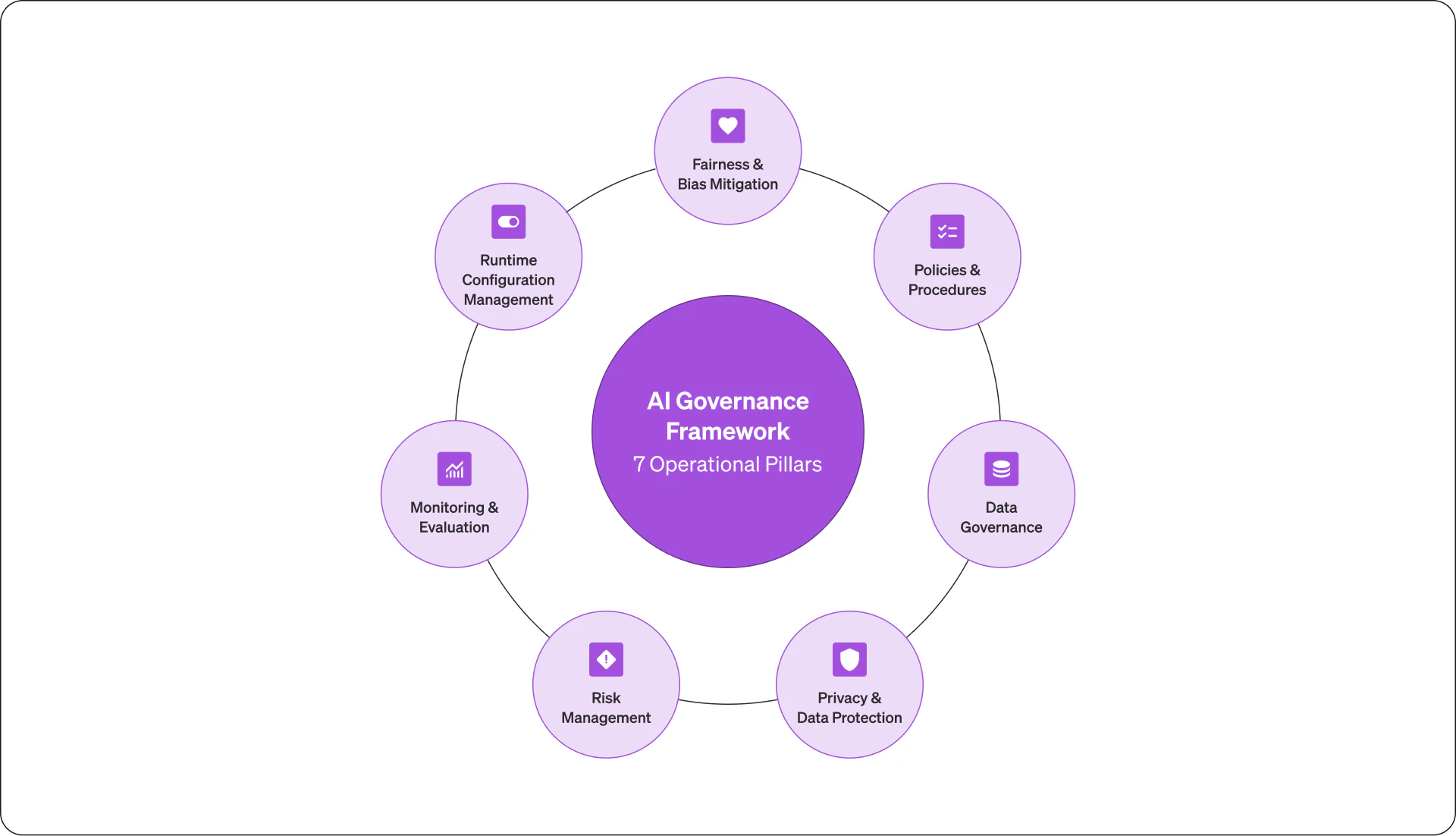
The 7 operational pillars of an effective AI governance framework.
Notable AI governance frameworks and regulations
Operational controls should be mapped to the external frameworks, standards, and legal requirements that apply to an organization. Three common reference points are:
Framework or regulation | Role in AI governance |
|---|---|
A voluntary framework organized around Govern, Map, Measure, and Manage that helps organizations incorporate trustworthiness into AI risk management. | |
A risk-based legal framework for AI systems in the European Union. Applicable obligations depend on factors such as the organization’s role, the system’s use, and its risk classification, so implementation should involve legal and compliance specialists. | |
An international standard specifying requirements and guidance for establishing, maintaining, and continually improving an AI management system. |
These references operate primarily at the organizational and regulatory levels. The seven pillars below focus on the operational mechanisms teams can use to put governance into practice.
Fairness and bias mitigation in AI systems
Fairness in AI systems is not something you can assume once a model appears to work well overall. Performance often varies across user groups, language styles, and usage contexts, which means fairness has to be defined, tested, and monitored as part of normal production operations.
Define fair for the feature
Fairness has to be defined in terms of who is affected and which outcomes matter. For an AI customer support assistant, fairness may not mean giving every user the same answer. It can imply that users in different regions, language styles or types of accounts should get equally helpful responses, equal chances of escalation, and equal refusal rates. When teams fail to establish equity in those practical, feature-based terms, they might find themselves monitoring overall performance without meaningful disparities among user groups.
The YAML-style configuration examples in this article are illustrative pseudocode, not literal AgentControl configuration syntax. This kind of definition makes fairness operational by spelling out which user groups matter, which outcomes should be compared, and what level of variation should trigger review.
Run bias checks before release
After the definition of fairness, it has to be tested similarly to how you test regressions in latency, safety, or functionality. An effective evaluation set would consist of prompts of the major user groups and generic edge cases, including putting the same question in a formal, informal, or non-native language. Running those checks every time the prompt, model, retrieval layer, or supporting data is updated helps teams catch unbalanced execution before it reaches extensive traffic.
AgentControl can keep prompts, model settings, and tool definitions versioned and reviewable. CodeControl or feature flags can limit an affected application path to controlled cohorts while you compare quality metrics. Teams can rerun fairness checks with an evaluation framework or internal regression suite whenever the system changes.
Monitor fairness after rollout
Fairness will not cease to become an issue when the feature is launched. Production behavior can shift over time, and aggregate measures can mask the reality that a specific user group is not performing as well as others. Live signals must be tracked by monitoring the quality of answers, refusal rates, escalation rates, cohort feedback, and addressed swiftly in the event of any disparity noted by the team. They can minimize exposure, make comparisons between affected groups and a baseline, and roll back to a safer configuration when necessary because of targeted rollouts and fast rollback controls.
Segment-level observability dashboards can help you surface drift and performance disparities that aggregate metrics would otherwise hide.
Policies and procedures for AI governance
Policies matter not only for compliance and audit, but also for how the system behaves in practice. The governance of AI in production involves translating broad objectives into detailed, structured regulations. This framework dictates critical aspects such as who has access to the tools, how legitimacy is reasoned, and what options are available for system rollback. The closer a policy is to runtime behavior, the better it is in the case of a changing condition.
Write and enforce rules engineers can implement
AI governance is only effective when the rules that engineers are to implement are translated into policies. At the feature level, teams are expected to define the scope of what the system may do, what it should refuse, and how it needs to respond if requests are out of scope. The advice must be specific enough to include prompts, tool access, validation logic, and escalation behavior. General policy statements can be helpful in management, but it is necessary to have rules that are exactly relevant to code and runtime controls.
When a customer support assistant is being guided by a general statement to be safe, they should not be controlled by this order alone. It must have clear boundaries around the account activities it can help with, which areas it should refuse, and situations that need to be escalated to a human being. Those must also be implemented in the request path using tool allowlists, input validation, sensitive data handling, output constraints, and refusal conditions to reduce the chance that the model goes beyond its intended limits. This is intended to support making the safe path the default path, with guardrails consistently configured to work.
Version and rollback policy changes
AI policy changes must be versioned and should be reviewable, just like application code. System behavior can be influenced by prompts, rules, model settings, and tool permissions; therefore, you should have a clear record of what, when, and who approved it. LaunchDarkly AgentControl is designed to handle this by storing information as versioned prompts, model selection, parameters, and tool definitions, with audit trails. That provides teams with a consistent method of testing policy changes by rolling out controlled changes, implementing dynamic rules by substituting variables like {{user_role}} and {{allowed_actions}}, and rolling back to a prior configuration without having to redeploy the application.
This kind of configuration makes policy changes explicit and reviewable. Teams can see which prompt version is active, which actions are allowed, how much traffic is exposed, and which earlier version to revert to if the update causes problems.
A lack of such traceability would mean that you are aware that behavior changed, but would not know what policy update changed it. Policy governance works through versioning and rollback to make changes, something that teams can test, revise and undo safely.
What is AI data governance?
Data governance shapes what the model knows, what it can trust, and how safely it can operate in production. Even a strong model can produce weak results if it is fed stale, low-quality, or unverified context. For that reason, governing data inputs, freshness, and traceability is as important as governing the model itself.
Control approved inputs
The first stage of AI data governance is controlling what the model can access. Teams should select sources of retrieval, tools, and supporting datasets, and prevent low-trust, irrelevant, or unverified inputs from entering the model environment. This is important since the quality of information around the model greatly affects the quality of the model. Viewing data as a controlled production dependency will minimize the chance that poor sources, noisy access, or unknowingly broken tool output will subvert system behavior in the long run.
Teams enforce this through allowlisted retrieval sources, curated vector indexes, and service-side filters that prevent low-trust content from reaching the prompt.
Enforce freshness and provenance
Teams must also be aware of the sources of context that they obtained, the last time they were updated, and whether they can be utilized in the current task. Without freshness and provenance controls, old or untested material can take over the model's response even when the underlying model is operating correctly. A good governance strategy traces source origin, update time, and level of trust, which helps keep retrieval grounded in current, accepted information. A sound governance strategy tracks metadata such as source origin, update time, trust level, and retrieval path so you can confirm that responses rely on approved and current information. That metadata should be handled carefully when user context is involved, especially where PII or other sensitive identifiers may appear.
Teams may pin a model version to reduce unplanned behavior changes, but a pinned version can become less suitable as policies, source data, and user needs evolve. They should evaluate outputs to decide whether the predictability of a pinned version or the capabilities of a provider’s latest version offer the better tradeoff, using offline evaluations before a switch and online evaluations after release. AgentControl Adaptive Triggers, currently in closed beta, can route traffic to a predefined fallback configuration when selected quality or operational signals cross a threshold. Regardless of model version, retrieval freshness and provenance controls remain necessary because an apparently fluent response may still rely on stale context.
In retrieval-heavy systems, data-lineage and response-tracing systems can help you determine not only what the model returned, but also which source content shaped the answer.
Make changes auditable
Datasets, indexes, and retrieval configurations also need to be versioned and logged to allow teams to know what was on at any point in time during a response. The audit trail is key to debugging regressions, tracing the origin of failures, and safely rolling back the process whenever behavior changes. The same can be said about the operational tooling around the model. For example, context fields in AgentControl or similar runtime controls should not contain PII; opaque identifiers should be used, allowing governance metadata to remain useful for debugging and rollout control without revealing sensitive personal information.
Teams can combine versioned runtime configurations in AgentControl with response-tracing and data-lineage systems. This creates complementary records of the configuration that governed the response, the execution path, and the source data involved, without implying that any single tool replaces the others.
Privacy and data protection in AI governance
Protecting privacy in AI systems begins long before the model provides an answer. It relies on restricting the exposure of sensitive data to the model, managing the storage and monitoring of that data by surrounding systems, and applying access rules outside the model. Practically, however, the best way to have privacy is to make sure that there is minimal exposure at each stage of the pipeline.
Minimize and redact sensitive data
The first step towards protecting privacy is minimizing the extent to which sensitive information is ever passed to the model. It is preferable that only data needed to get the job done is sent to these systems, and sensitive fields are redacted or tokenized where inference is possible. Prompts and attached context should avoid including secrets, credentials, or unnecessary personal information unless their use is strictly necessary and governed by appropriate controls. For systems subject to the GDPR, you should review this design against applicable data-minimization and privacy obligations with their legal or privacy specialists. This decreases the likelihood of the model leaking private data in its results and minimizes the volume of sensitive data passing through the AI stack in the first instance.
A healthcare or support assistant may need a case summary or account status to answer a question, but it rarely needs raw identifiers, full payment details, or complete personal records. The less sensitive data the model sees, the smaller the privacy risk becomes.
Secure logs and traces
Privacy controls also need to extend beyond inference to the observability layer around the model. Prompts, retrieved context, tool outputs, logs, and traces can all become secondary stores of sensitive information if they are captured too broadly. Teams should avoid retaining raw sensitive data in these systems, apply strict access controls, and set retention limits that match actual operational needs.
Simple privacy controls like the ones below show how you can reduce exposure in observability systems. Sensitive fields are redacted, internal identifiers are tokenized, and logs are configured to avoid storing raw prompts or unmasked tool output longer than necessary.
Teams often combine redaction pipelines with tracing and observability systems, configuring those pipelines to mask sensitive fields before prompts, tool outputs, or metadata are stored.
Enforce access outside the model
Authorization should not be delegated to the model itself. Application code must impose identity checks, permissions, and decisions by using allowlists, validation, and service-side controls before the model can act on a request. This is particularly significant in controlled AI systems, where the model can come up with convincing but unauthorized actions when it is left to interpret access rules independently.
The same applies to runtime controls and targeting metadata. Teams should use opaque identifiers instead of PII wherever possible. LaunchDarkly private context attributes allow selected attributes to be used in targeting rules without sending their values to LaunchDarkly or displaying those values in the dashboard, preserving useful rollout controls while limiting unnecessary exposure of personal data. When the model is considered as an untrusted entity on which access control decisions are based (as opposed to the system of record of who is authorized to do what), privacy becomes far easier to defend.
Risk management as part of AI governance
AI risk rarely comes from a model failing in only one obvious way. More often, it comes from small errors combining with weak controls and surfacing under real production conditions. That is why risk management in AI is not just about identifying failures, but about containing them before they become incidents.
List failure modes and severity
Risk management starts with the naming of the ways the system can fall short of production. Teams are supposed to list probable failure modes that may happen, like hallucinations, unsafe or inaccurate output, prompt injection, data leaks, overgeneral refusals, and unsafe actions of the tools, then rank them by the impact on the user and business risk. This forms a viable basis of governance since not all failures merit the same controls and response route. The issue of low-risk formatting and unauthorized action that is high-risk should not be treated similarly.
In an IT operations copilot, a harmless formatting mistake is minor, but a model recommending or triggering the wrong production action can become a serious incident.
Add layered guardrails
Lack of control is one of the biggest AI risks, and an AI governance framework should help organizations minimize it. After defining failure modes, teams are to install several precautions because one model error does not become an incident.
Such safeguards may involve filtering inputs, restricting tools, validating outputs, refusal controls, and checks on any intervention the model attempts to cause. CodeControl feature flags can add application-level controls by restricting risky paths to selected cohorts, progressively releasing them, or disabling non-core functionality through a kill switch. These controls complement rather than replace model-level validation and policy enforcement.
It is not to assume that the model will necessarily act correctly, but to create the system in such a way that errors are bounded. The layered guardrails make risk reduction operational by ensuring that if one control fails, another remains in place to contain the blast radius.
Prompt-level safeguards are often paired with application-level middleware, output-validation systems, and policy checks so model output is reviewed before sensitive downstream actions are executed.
Plan safe modes and response
Teams should also have a set of fallback states to use in case production signals are sent to alert that normal operation is unsafe. These safe modes could turn off some of the tools, reduce the capabilities of the model, constrain prompts, or send sensitive cases to human inspection. AgentControl has implementable fallbacks that can help you create distinct configuration variations: a full-capability version and a restricted version with fewer tools and more conservative instructions. Such variations may be deployed through a guarded rollout, targeted to specific traffic, or switched in real time through the dashboard or API without redeploying code.
Before an incident has occurred, a configuration such as the one below can make that fallback behavior explicit. Teams are able to pre-set which tools remain active, which actions are prohibited, and which signals get a safer operating mode, rather than improvising in response to a production issue.
Monitoring and evaluation for AI governance
When launching, start with monitoring and evaluation. Quality in AI systems may change due to a timely edit, a retrieval adjustment, or a model modification; therefore, you must have a mechanism to test before release and continue monitoring after traffic is live. The aim is not merely to monitor behavior, but to relate such indicators to the rollout action the system may pursue.
Gate changes with offline tests
Monitoring should begin before anything reaches production. Teams should use golden sets, regression suites, and adversarial test cases to evaluate changes to prompts, models, retrieval systems, and tools before wider exposure. AgentControl offline evaluations provide a repeatable workflow for comparing prompt and model variations against datasets and scoring criteria. Teams may still need external or in-house harnesses for retrieval and tool components managed outside AgentControl.
These offline checks assist in early detection of regressions and provide a repeatable baseline to assess whether a new configuration is really better or if it is simply different. In the case of AI systems, it would be crucial to have such rigorous pre-release testing since a minor alteration may introduce unforeseen behavioral changes.
On one hand, a search assistant, e.g., might be better after a timely refresh since responses become shorter and quicker; on the other hand, a regression package reveals that the quality of citations and factual basis deteriorated. Offline evaluations help you identify these tradeoffs before they affect users.
Teams typically run these checks through evaluation systems or in-house regression harnesses so prompt, model, retrieval, and tool changes can be compared with a fixed baseline before release.
How to monitor production signals and tie them to rollout control
After a feature is live, it must be evaluated across versions, cohorts, and rollout groups. Signals that you should monitor include: tool failures, refusals, escalations, feedback, latency, cost, and other quality indicators that indicate drift or instability with time. Cohort monitoring is particularly significant since aggregate measures can obscure issues specific to groups of users or traffic. To reinforce this process, online evaluations use attached judges to score live outputs for measures such as accuracy, relevance, and toxicity, helping teams understand model quality during rollouts rather than relying only on operational metrics.
With progressive rollouts or guarded rollouts, you can limit exposure, monitor relevant metrics, and stop or roll back a change when signals degrade. AgentControl can facilitate this by recording configuration changes with timestamps and audit history, which makes it simpler to trace shifts in production measures back to particular prompts, models, or policy changes. When a new configuration results in the quality declining or risk increasing, teams can roll back or be exposed to the new configuration without necessarily a full redeployment.
Observability and experiment-tracking platforms can help you compare live behavior across versions and cohorts, while LaunchDarkly provides the runtime controls used to adjust exposure or reverse a release.
Runtime configuration management for AI systems
In AI systems, important behavior often changes without a full application release. Prompts, model settings, tool permissions, and routing rules can all alter how the system behaves in production, which is why AI runtime configuration management is an essential component of an AI governance framework. When those changes are versioned, tested, and reversible, governance becomes much easier to apply in day-to-day operations.
Version model behavior as configuration
Prompts, model parameters, tool definitions, routing rules, etc., are to be addressed as governed runtime configuration in production AI systems, instead of being buried inside application code. These environments have a direct impact on model behavior; thus, they must be as disciplined as other production controls: versioning, reviewability, and clear ownership. Treating them as configuration simplifies knowing what has changed, testing safer alternatives, and preventing behavior changes, which are hard to test, from being bundled into entire application deployments.
That makes it much safer to experiment as well. Teams must have the capability to pilot new prompts, model setups, or tool permissions before wider deployment using approaches such as canary releases or A/B testing, and compare performance across versions and cohorts. This decreases the likelihood of introducing large-scale regressions, and it makes governance more achievable since changes can be tested at realistic production levels rather than being considered an all-or-nothing release.
LaunchDarkly AgentControl helps groups manage prompts, model settings, and tool definitions as versioned runtime controls and then roll them out gradually instead of linking every behavior change to the deployment of a code change.
Enable fast rollback and auditability
Strong governance requires the capability to undo risky decisions within a short time and clarify what and why they occurred later. This can be facilitated using LaunchDarkly AgentControl, which stores prompts, model selection, parameters, and tool definitions as versioned configurations along with audit trails of who changed what and when. That helps you roll back in real-time without redeploying code, associate production problems with certain configuration changes, and have a transparent history of operation to review incidents, improve compliance, and for ongoing improvement.
In the absence of such auditability, teams can be aware that behavior has changed, but they can not articulate the reasons. Fast rollback minimizes operational risk in the instant, whereas audit history facilitates easier investigation of any incident, helps meet governance requirements, and enhances future rollout decisions.
A configuration like the one above shows how model behavior can be managed at runtime rather than buried in application code. Prompt versions, model settings, tool permissions, rollout scope, and rollback targets are all explicit, which makes changes easier to test, review, and reverse.
FAQs
How is AI governance different from AI compliance?
AI governance is the ongoing operational work of controlling how a system behaves in production; compliance is demonstrating that work satisfies an external standard. Governance covers runtime guardrails, staged rollouts, monitoring, and rollback paths. Compliance maps those same controls to obligations such as the EU AI Act or ISO/IEC 42001.
Does the EU AI Act apply to my AI system?
It depends on your organization's role, how the system is used, and its risk classification. The EU AI Act is a risk-based legal framework, so obligations vary rather than applying uniformly. Because that analysis is legal rather than technical, involve legal and compliance specialists before deciding which requirements attach.
How do you start building an AI governance framework?
Start with one production AI feature rather than an organization-wide policy document. Define what that feature may and may not do, encode those limits in prompts, tool allowlists, and validation, then add offline evaluations before release and cohort monitoring after. Extend the same pattern to the next feature once it holds.
Do you still need AI governance if you use a third-party model?
Yes. You do not control the provider's model, but you do control the prompts, retrieval sources, tool permissions, and rollout scope around it, and that is where most governance actually happens. Provider version changes are also a reason to pin models, evaluate outputs, and keep fast rollback available.
Conclusion
AI governance is what keeps an AI system reliable after it goes live. Models, inputs, tools, and user behavior all change over time, so safety and quality cannot be treated as one-time launch checks. A strong AI governance framework gives you clear boundaries, runtime safeguards, staged rollout controls, monitoring, auditability, and recovery paths. That makes governance practical: teams can test changes carefully, release them gradually, monitor live behavior continuously, and respond quickly when real-world conditions shift.
Where to go next
- AgentControl — versioned prompts, models, parameters, and tools with a full audit trail.
- Judges — configure the scoring behind online evaluations.
- Online evaluations — sample live output for accuracy, relevance, and toxicity.
- AgentControl Quickstart — set up versioned, auditable runtime configuration.